
The Foundation Decision Behind 'Still Working On It' Years
There's a specific kind of stuck that doesn't look like stuck.
You have notes. You have research folders. You've read more about online business than most people who are already selling. You can explain your industry better than half the people operating in it. And you haven't shipped anything.
If you've been telling people you're "working on something" for over a year, and the people around you have quietly stopped asking how it's going, this is for you. The reason you're still in this phase has almost nothing to do with discipline. It has to do with one architectural decision you've been treating as optional.

The Pattern
Watch this pattern long enough and something specific shows up. Not procrastination, exactly. Something more like a sophisticated strategy for staying safe.
The folders multiply. The desktop has a 2024 plan, a refined 2025 plan, and three different "starting over" documents. The notebook beside the laptop has good handwriting on the first thirty pages and almost nothing after that. There are 17 PDFs in Downloads that were going to change everything. There are 247 videos in Watch Later. There are 180 unread emails in a folder labeled "Business Ideas."
Around month six, friends quietly stop asking how it's going. Not because they don't believe in you. Because the story hasn't changed. They've heard the same explanation in four different versions across two years, and politeness eventually finds a different conversation.
What this looks like from the outside is unfocused. What it feels like from the inside is the opposite. You are tracking too many threads. You're factoring in too many variables. You're thinking carefully about the offer, the audience, the platform, the price, the niche, the timing, the framing, the funnel. Every time you get close to one decision, three more questions appear that need to be settled first.
The stack of "before this can happen, that has to happen" keeps growing without a visible top.
There's a behavior underneath this, and it isn't laziness. It's protection. The moment you commit to a specific answer, you create the conditions to test that answer. A test has an outcome. The outcome might confirm something you've quietly been afraid of for a long time. So the research phase isn't avoidance. It's a buffer.
As long as I'm still figuring it out, I haven't been wrong yet. I'm just not done.
Why the Usual Fixes Fail
Most people in this position try to solve it by adding more.
A new method. A new framework. Another course on the topic they've already studied. A productivity overhaul: a Notion second brain, a Sunday planning ritual, a deep work block. A fresh start with a new niche or a clean domain that doesn't carry the weight of the previous attempts.
All of these treat the surface. None of them touch the foundation.
Adding another method doesn't help when the problem isn't a lack of methods. You don't have a productivity gap. You have a hundred open architectural questions and none of them will close until the first one does.
The productivity systems fail for a related reason. A planner is a tool for organizing decisions you've already made. When the underlying decisions are still open, the planner becomes another container for the same loop, more elaborate, more aesthetic, more time consumed. The Sunday planning session that takes two hours and ends with the same plan as last Sunday isn't a planning problem. It's a foundation problem wearing a planning mask.
Fresh starts fail most clearly. The new niche carries the same unresolved questions, just in a new costume. The new domain is the old domain after a haircut. Six weeks in, you recognize the rhythm. You're back to comparing options, listing pros and cons, asking which of the seventeen possible directions feels right. The cycle didn't end. It restarted with a fresh notebook.
What's actually happening in all three patterns is the same thing. There's one decision in the structure that's load-bearing. Until that decision closes, everything downstream stays tentative. Your offer feels uncertain. Your audience feels unclear. Your timeline keeps moving. You're not stuck because you're doing something wrong. You're stuck because you're treating a foundation problem like a decoration problem, and those don't have the same solution.

The Reframe
Here's the architectural distinction that changes everything.
A foundation question is the one every other question in your business is secretly waiting on. It's almost never the question that feels most urgent. It's usually the one that feels most ordinary, so ordinary you've assumed it must already be settled.
In practice, this question almost always shows up as some version of: "What exactly am I building, and for whom?"
That sounds too simple to be the answer. It looks like a starter question, the kind of thing you'd settle in the first week before moving on to the real work. But notice what happens when you actually try to answer it in one honest sentence, with no hedging, no qualifiers, no "well it depends on whether…"
The sentence resists. It splits into options. The options proliferate. You feel the same pull you've felt for the last year toward "let me think about this more before I commit." And there's the foundation question, hiding in plain sight, doing exactly what it's been doing the whole time.
Every other obstacle you've named (no audience, unclear offer, no time, no funnel, no list, no idea where to start) traces back through three or four layers to this same upstream question. When you can't answer it, you can't answer them either, no matter how much research you do on each one in isolation. When you can answer it, the others stop being independent questions and start being downstream tasks of one decision.
This is the difference between a pile of things to figure out and a sequence to walk through.
A pile is heavy. A sequence is just the next step.
The Three Foundation Moves
If you've been in the figuring-it-out phase for over a year, here's a way out that doesn't require a new course, a new framework, or a new identity.
Move 1: Stop asking what you should work on. Start asking what decision you've been avoiding.
There's a question in your business right now that you've been treating as optional. It isn't optional. Every time you sat down to plan your next move over the past year, you walked around it. You probably already know what it is. It looks like a niche question or an offer question or a price question on the surface. Underneath, it's one specific thing.
Spend ten quiet minutes naming it. Not what you should do next. That's not what's stuck. What decision have you been refusing to make because the answer might be uncomfortable? Write that question down on its own line. Don't answer it yet.
Move 2: Write the foundation sentence in fewer than thirty words.
Take the question from Move 1 and write your honest answer in one sentence, under thirty words.
Not a paragraph. Not a hedged maybe. One sentence. It will feel incomplete. It will feel like there are nineteen caveats you should add. Don't add them. The sentence will be wrong in some way and that's not what matters here. What matters is that it exists outside your head.
An imperfect foundation you can stand on is still a foundation. A foundation you're still refining exists only in your head, and nothing real ever gets built on something that lives only in your head.
Move 3: Make one thing visible in the next fourteen days.
Choose one thing to build on that sentence, starting today, with a fourteen-day cap.
A page. An offer. A first version of the thing you've been preparing to build. It doesn't have to be polished. It has to be visible. The moment something exists outside your private documents, outside Notion, outside your notebook, outside your head, you stop being someone who is working on something and start being someone who has something live.
That shift does not happen gradually. It happens at one specific moment, and you get to pick when. You also get to make it imperfect, because imperfect-and-visible beats perfect-and-private every time.
Why It Works
The reason this works is not motivational. It's structural.
The "still working on something" loop isn't a discipline problem. It's not a focus problem. It's not a procrastination problem. It's a structural one. When the load-bearing decision in your business stays open, every downstream decision has to leave room for the possibilities the upstream decision hasn't closed yet. Each downstream choice carries the weight of every possible version of the upstream answer. That's exhausting, which is exactly what it feels like.
The instant the foundation decision closes, even imperfectly, the weight reorganizes. The downstream questions stop being open-ended. They become a sequence: do this, then this, then this, in this order, because the upstream decision dictates the answer.
One foundation decision turns a hundred open questions into a single clear starting point. The sequence does the rest. You're not asking yourself "what should I be working on" twenty times a day, because what to work on is now obvious. There's one next visible thing. You either do it or you don't, and either answer tells you something useful.
Where to Start This Week
You don't need another course. You don't need more motivation. You need the foundation decision that closes the rest.
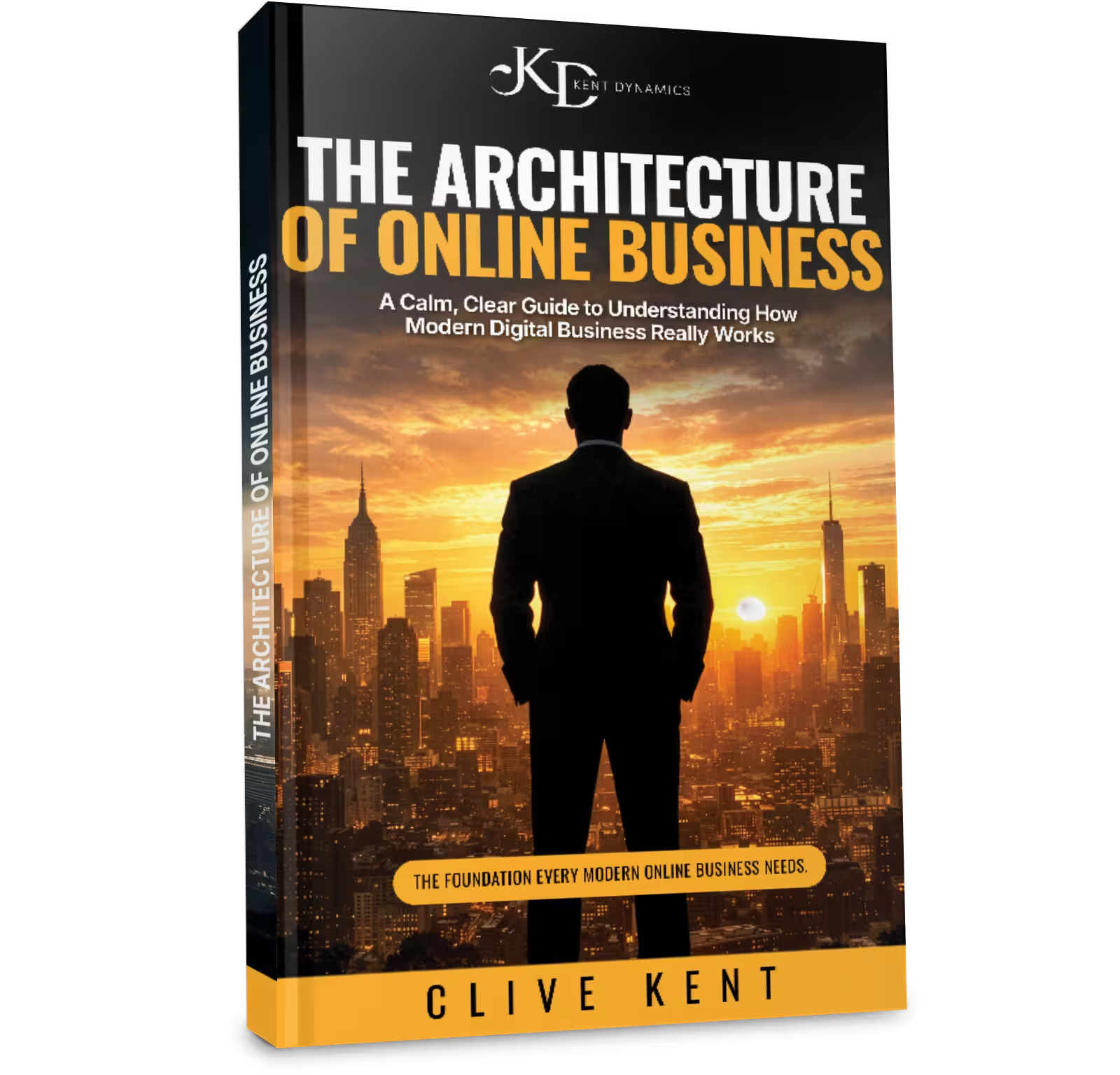
If you want the full architecture, the complete decision sequence, the failure modes, and the foundation moves laid out chapter by chapter, that's exactly what The Architecture of Online Business covers. It walks through the load-bearing decisions every online business has to make, in the order they have to be made, and it names the false beliefs that keep most builders stuck in the figuring-it-out phase indefinitely.
If "still working on it" describes where you've been for over a year, the book is the most direct path I know out of that loop and into something visible.
Start with clarity
Clive Kent
If you’re building a digital business and want a clear, practical understanding of how it all fits together, this short book will give you the foundation to move forward with confidence.
YOU MIGHT ALSO LIKE

Kent Dynamics
About Kent Dynamics
Kent Dynamics is a creative and content support business working with entrepreneurs and small businesses building digital products and online brands. We provide practical design, content, and media support through a collaborative, conversation-led approach.


Start with clarity
If you’re building a digital business and want a clear, practical understanding of how it all fits together, this short book will give you the foundation to move forward with confidence.
Clive Kent
Kent Dynamics LLC provides creative and content support services to entrepreneurs and small businesses.
All products offered by Kent Dynamics LLC are digital unless otherwise stated. No physical goods are shipped.
Operating internationally.
© 2026 Kent Dynamics LLC. All rights reserved.
Home | Disclaimer | Terms and Conditions | Privacy Policy
For enquiries: hello@kentdynamics.com