
Why You Can Explain Online Business But Can't Build One
You can explain how a funnel works.
You could sit a friend down and walk them through the whole thing, the lead magnet, the email sequence, the offer, the upsell, the way traffic moves through it. You have read enough, watched enough, and bought enough that you could practically teach it.
And you have never built one of your own. There is nothing live with your name on it. If that gap describes you, it is worth understanding what it actually is, because it is not the gap you think it is, and the usual fixes only make it wider.

The Meeting You Could Run in Your Sleep
There is a particular kind of person this happens to, and it is not the person who lacks ability. It is usually the opposite.
You spend your workday being good at things. You run a meeting and walk a room through a quarter's numbers, a project plan, a hiring decision, and you are clear and you are persuasive and the room follows you. You have been doing some version of this for eighteen years, long enough that you could do it half asleep, and on some mornings you feel like you are. The competence is automatic now. People praise you for it, and the praise makes you flinch a little, because they think this is who you are.
Then you come home and open the laptop, and the thing you actually want to build just sits there.
You bring the same intelligence to online business that you bring to work. You have read about funnels until you could diagram one from memory. You understand email sequences, lead magnets, the offer, the order bump, the upsell. You have opinions about which approaches are worth following and which are noise. You could walk a friend through the whole architecture of an online business over coffee, and they would leave impressed.
And there is still nothing live. There is a folder on your desktop called Online Business Stuff that you have not opened in six months. There is a Google Doc with a working title and almost nothing under it. The business exists in complete and confident detail inside your head, and nowhere else.
This is the gap. Not between you and the knowledge. You have the knowledge. The gap sits between everything you understand and the single smallest thing you have put into the world. And the strange part is that the understanding keeps growing while the built thing stays at zero.
Why the Next Course Was Never the Missing Piece
So you do something about it. The move is almost always one of two things, and you have probably tried both.
The first is to learn more. You find another course, a better one, a more advanced one, the one that finally promises to connect the pieces you already have. You have done this several times. There was the $497 course you finished maybe a third of. The $697 program where you watched four modules and meant to come back. The $297 training you bought on a Sunday night, full of resolve, and never opened. Each purchase felt like the missing piece. Each one was, for about a week, because buying a course and starting a course both feel like progress, and learning always feels like motion.
But you already had enough. You had enough after the first one. Another explanation of the same system was never the thing standing between you and a built funnel, which is why the third explanation landed exactly like the first: clear, interesting, and followed by nothing.
The second move is to fix yourself. If knowledge is not the problem, maybe discipline is. So you reorganize. A new planner, the one with the better layout. A cleaner Notion workspace, redesigned for the fourth time. A focus app, a quiet morning blocked off, a fresh resolution to finally be the kind of person who follows through. For a few days it feels like control. The inputs are tidy. The desk is clear.
But a tidy workspace does not build the funnel either. A reorganized Notion is still not a live page. You can sharpen the tools forever without ever cutting anything with them.
Both moves are reasonable. Both feel like work. And both quietly assume the gap is a knowledge problem or a discipline problem, when it is neither. That assumption is why the same loop keeps closing on the same defeat, just better organized each time.

What Understanding Quietly Skips
Here is what is happening underneath. Understanding and building are not the same skill, and they fail in different ways.
When you learn about online business, the knowledge arrives all at once and in no particular order. A video about offers one night. A thread about email another. A course module about traffic somewhere in between. You collect the pieces the way you collect facts, whichever one caught your attention that evening, and you store them flat, side by side, all equally important. In your head, the whole system exists as a kind of map with everything visible at the same time.
But a structure is not a map. A structure has an order. It has a thing that must be decided before the next thing can be decided, and a thing after that, each one resting on the one below it. The reason your understanding has never turned into a built business is that understanding gives you all the pieces at once and never tells you which one goes first.
And one piece does go first. Underneath the funnel, the emails, the traffic, the audience, the offer, the pricing, and the platform, there is a single upstream question everything else depends on: who is this for, and what is the first thing I will sell them. Until that question is answered on paper, in plain words, outside your head, every other piece stays tentative, because every other piece has to leave room for all the answers you have not closed yet.
That is why it feels exhausting. Every downstream choice is carrying the weight of every possible version of the upstream one. The funnel you imagine has to work for six possible audiences. The email has to fit four possible offers. No wonder it never gets built. You are trying to frame the second floor while the foundation is still a list of options.
Three Moves From Knowing to Built
Closing the gap does not require more understanding. You are already past that. It requires three moves, in this order.
Make one small thing real this week
Not the whole business. The whole business is the thing you have been understanding for three years, and it is too big to build in a week, which is part of why it never gets built. Pick one piece and make the smallest complete version of it that can exist outside your head.
An offer written in plain words on a page. A simple landing page someone could actually arrive at. One email that could go out tomorrow. It does not need to be polished. It does not need to be the final version. It needs to be real, which means it needs to live somewhere other than your notes and your imagination.
The point of this move is not the page itself. The point is the shift it forces. The moment something is real, you stop being someone who is working on something and start being someone who has built one thing. That is a different identity, and it changes what you do next. You cannot think your way into it. You can only build one small thing your way into it.
Build in order, not by interest
This is the move understanding skips, and it is the one that matters most. You have been building by interest, working on whichever piece feels most appealing on a given night. Some nights that is the brand name. Some nights it is the email welcome sequence. Some nights it is researching the perfect platform.
Building by interest keeps you busy and keeps you stuck, because the pieces do not depend on your interest. They depend on each other, in an order. And the first decision in that order is the one you have been avoiding, precisely because it is the one that closes the others: who is this for, and what will I sell them first.
Make that one decision, on paper, and watch what happens to the rest. The funnel stops being a mystery and becomes a task. The emails stop being a question and become a list. The thing that felt like twelve open problems turns out to be one decision and eleven consequences of it.
Put it in front of one real person
Understanding lives in private. It is safe there. No one can watch an idea fail inside your head, which is exactly why the idea prefers to stay there. The whole reason the research phase is so comfortable is that nothing in it can be judged.
Building happens in the open. So the third move is to put the imperfect version in front of one real person before you feel ready, because you will not feel ready, and ready is not coming. Send the page to one person who fits the audience you just defined. Show the offer to one person who might pay for it. Ask one human being to look at the thing.
One real person seeing it is enough. It converts the project from something you can explain into something that exists and has been witnessed. After that, going back to pure understanding gets much harder, because the thing is out there now, and you are the person who built it.

Why the Order Is the Load-Bearing Piece
It is worth being precise about why this works, because the precision is the point.
The gap between explaining and building was never a knowledge gap. You proved that yourself, every time another course landed and changed nothing. It was a sequence gap. Understanding hands you all the pieces at once and no order to assemble them in, and the order is the load-bearing piece. It is the one thing consumption never supplies, because no video, course, or thread can decide for you what you are building and who it is for. They can only describe the pieces.
The moment you build in sequence, starting with the one upstream decision and letting the rest follow, knowing turns into something that exists. Not because you finally found enough discipline. Not because you found the right course. Because the structure finally had a first stone, and the second stone had somewhere to sit.
The competence you have always had stops being something you perform and becomes something you use. That is the difference. That is the entire difference.
Start With One Real Thing
You do not need to understand more. If anything, you understand too much for how little you have built, and that imbalance is not a character flaw. It is a sequencing problem, and sequencing problems have solutions.
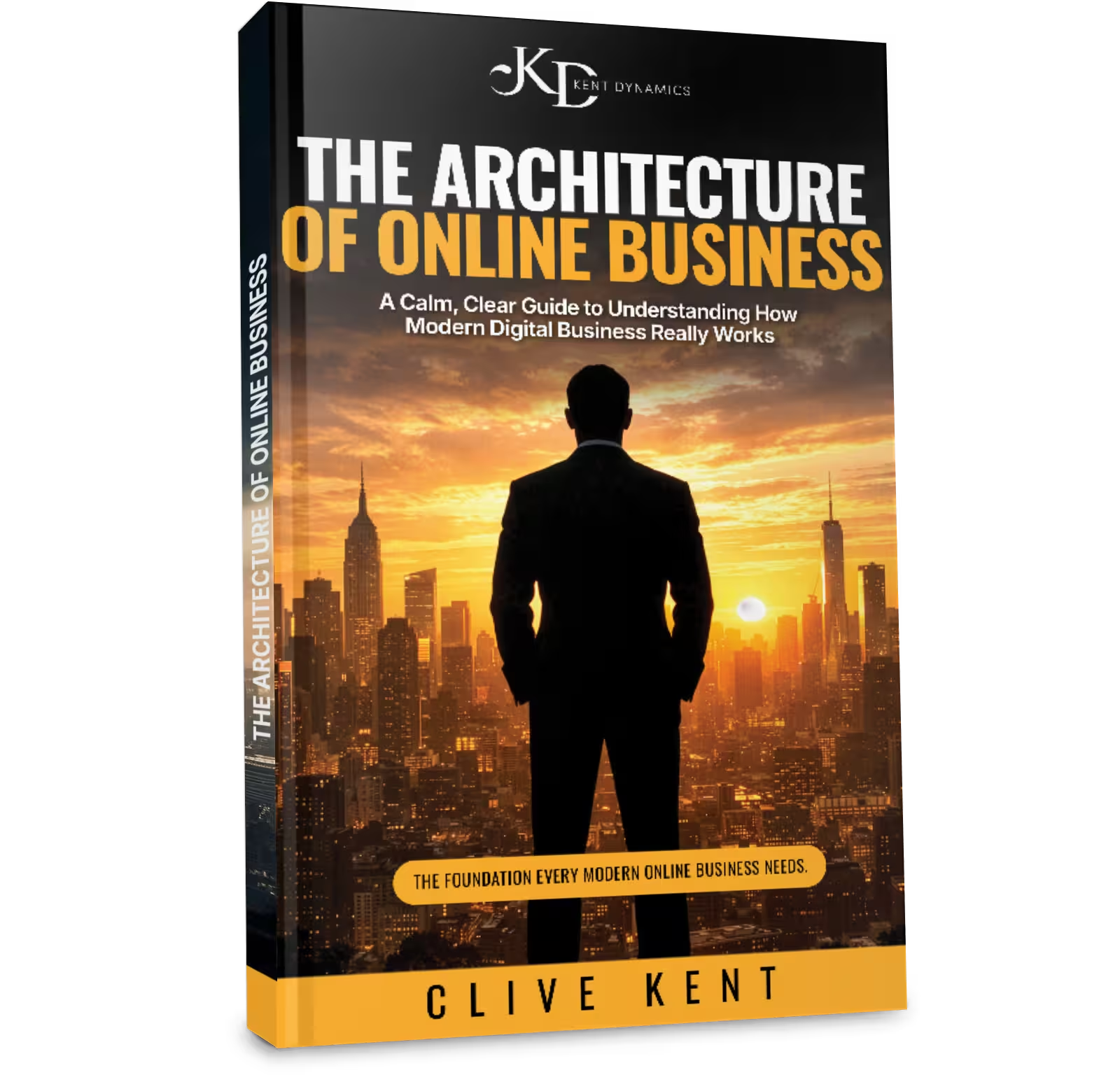
If you want the full version of what this post just walked through, the exact order the decisions go in, the failure points that show up along the way, and the foundation question laid out so you can actually answer it, that is what The Architecture of Online Business covers, chapter by chapter. It is written for the person who already knows enough and has built nothing yet, the person who is tired of being able to explain it and ready to finally have something to show for it.
This week, before you read another thing, pick one piece and make it real.
Clive Kent
If you’re building a digital business and want a clear, practical understanding of how it all fits together, this short book will give you the foundation to move forward with confidence.
YOU MIGHT ALSO LIKE

Kent Dynamics
About Kent Dynamics
Kent Dynamics is a creative and content support business working with entrepreneurs and small businesses building digital products and online brands. We provide practical design, content, and media support through a collaborative, conversation-led approach.


Start with clarity
If you’re building a digital business and want a clear, practical understanding of how it all fits together, this short book will give you the foundation to move forward with confidence.
Clive Kent
Kent Dynamics LLC provides creative and content support services to entrepreneurs and small businesses.
All products offered by Kent Dynamics LLC are digital unless otherwise stated. No physical goods are shipped.
Operating internationally.
© 2026 Kent Dynamics LLC. All rights reserved.
Home | Disclaimer | Terms and Conditions | Privacy Policy
For enquiries: hello@kentdynamics.com