
The 17 PDFs in Your Downloads: Why More Information Won't Save You
You know the folder I mean.
It started innocently. Someone you trusted recommended a guide. You downloaded it. You opened it on a Tuesday evening with a cup of tea and the intention of finally getting clear on this thing you've been thinking about for a year. By page eleven, something stopped tracking. Maybe a contradiction with a different course you'd taken. Maybe a question the author asked that you didn't have a good answer to. Maybe just a quiet sense that this wasn't quite the one. You closed it. You told yourself you'd come back.
A few weeks later, a different ad showed you a different angle, and that one felt fresher. Written by someone who clearly got it. You bought it. You started it. The same thing happened.
Six months in, you've got a folder full of opening chapters. A graveyard of "this one will be different" downloads. And you're embarrassed by the receipts, because each one cost you twenty or thirty dollars, and you can't add them up without flinching.
If that's a recognizable scene, this is for you. The problem you're carrying isn't the one you think it is.

The Hidden Logic of the Pile
The downloading pattern looks irrational from the outside. From the inside, it makes perfect sense. Every new PDF feels like the missing piece. Each purchase comes with a quiet inner statement: if I just had the right framework, the right script, the right system, I could move.
So you keep looking for the right one.
There's a real cost to this pattern beyond the dollars. Each unfinished PDF leaves a small mark on your sense of yourself. You start defining yourself as someone who collects rather than someone who builds. The Watch Later list grows past two hundred videos. The browser has bookmarks dating back to 2023. The folder labeled "Business Ideas" has 180 unread emails in it. The accumulation becomes a record of intentions that didn't translate.
What's especially difficult about this loop is that it doesn't look like failure from a productivity perspective. You're learning. You're researching. You're being thoughtful. You can hold an informed conversation about online business with almost anyone you meet. You can quote three different course creators. You can compare frameworks. You can spot bad advice when you see it. None of that has translated into a single thing live in the world that someone could buy from you.
The mismatch between what you know and what you've built is the wound. And the instinctive response to that wound is to learn more.
Why the Usual Fixes Don't Work
When the pile of unfinished PDFs becomes embarrassing, people typically respond in one of three ways.
The first is to get pickier. The next one has to be the right one, you tell yourself. So you research before buying. You read more reviews. You wait for the course that finally matches your exact situation. The problem with this approach is that it treats the issue as a selection problem when it's actually a structural one. The PDFs you've already downloaded are not failing you because they're bad. Most of them are competent work by people who have genuinely built things online. They're failing you because every one of them teaches tactics, and what you actually need is the structure beneath the tactics. The piece that explains how the tactics connect.
The second response is to commit to a system. The Notion second brain. The Sunday planning ritual. The deep-work blocks. The carefully labeled folder structure. These solve a real adjacent problem, but they don't touch the loop. A productivity system is a tool for organizing decisions you've already made. When the underlying decisions are still open, the system becomes a more elaborate container for the same loop. You feel productive for two weeks, then you notice you're using the system to organize the same questions, and the cycle restarts.
The third response is to abandon and start over in a new niche. Fresh domain, fresh notebook, fresh enthusiasm. Six weeks in, the rhythm comes back. The same comparison loops. The same long pros-and-cons lists. The new niche carries all the old unresolved questions in a slightly different costume.
What all three responses share is the assumption that more material, better organization, or a different starting point will eventually break the loop. None of them do, because the loop isn't fed by a shortage of any of those things.
The Architecture Beneath Every PDF
Here's the truth that almost no individual PDF will tell you, because each one is selling itself as the missing piece.
The PDFs you already own are teaching pieces of the same underlying system. Open three of them, look at the chapter titles, and the pattern is unmistakable. There will be an audience chapter. There will be an offer chapter. There will be a traffic or attention chapter. There will be a section on conversion, on email, on retention. The labels change. The examples change. The order changes. The tone changes. The author's preferred metaphors change.
The architecture beneath them is the same architecture.
What I mean by architecture is simple. Every sustainable online business needs three connected things: a specific audience whose problem you understand, an offer that solves that problem in a way they recognize, and a path between the two that makes it easy for them to pay you. That's the structure. The tactics, scripts, templates, and frameworks in every PDF you own are all variations on how to build one of those three components.
This is not a controversial claim inside the industry. It's just rarely stated this directly, because the directness undercuts the case for buying the next thing.
Once you see the structure, two important shifts happen. The PDFs you already own become useful, because you can read them with the question "how does this teach me to build my audience, my offer, or my path?" instead of "is this the right framework?" And the PDFs you haven't bought yet become unnecessary, because the structural problem they all claim to solve is the same structural problem, and you don't need a fifth version of it.

The Shift That Ends the Loop
If you want out of the loop, three steps land where lectures don't.
Step one. Stop downloading for one week.
Not forever. Not a vow. Seven days. No new PDFs, no new courses, no new bookmarks. The instinct will be intense. It will feel like you're missing the one that finally explains it. Resist that instinct anyway. The compulsion to find the next one is part of what's keeping you in the loop, and the only way to see the loop clearly is to step outside it briefly.
The discomfort during this week is information. Notice what shows up. Notice the urge to search. Notice the small panic when an ad scrolls past and you don't click. The panic is not telling you the truth about what you need. It's telling you about a pattern you've built.
Step two. Open three of the PDFs you already own.
Pick three at random from the folder. Don't read them cover to cover. Open each one to the table of contents. Read the chapter titles. Read the first ten pages or so. Then do the same with the next, and the next.
You'll start to notice the pattern. Every one of them is teaching some version of the same system. Audience, offer, path. The vocabulary will be different. The author's specific bias will be different. The case studies will be different. The structure will be the same.
This recognition is the entire point of the exercise. It's not about absorbing the content of any one PDF. It's about seeing the architecture become visible across them. The moment you can hold that structure in your mind, the next PDF you encounter loses most of its hold on you, because you can place it inside the structure instead of treating it as a competitor for the right answer.
Step three. Pick one decision and build one visible thing on it.
Look at the PDFs you opened. Notice which question every one of them keeps circling back to. For almost everyone in this loop, it's some version of: what exactly are you selling, and who is it for? That's the foundation decision. It's the audience-and-offer pair that everything else in your business is waiting on.
Make that decision this week. In fewer than thirty words, on a single page. Don't draft it for a month. Don't perfect it. Write a workable answer down. An imperfect foundation you can stand on is still a foundation. A foundation you're still refining exists only in your head, and nothing real gets built on something that lives only in your head.
Then build one visible thing on it. A simple page. A short offer description. A way for a real person to give you money, however small the amount, in exchange for something. It doesn't have to be finished. It has to be real. The moment something exists outside your private documents, you stop being someone who is working on something and start being someone who has something live. That shift doesn't happen gradually. It happens at a single moment, and you get to choose when.

Why It Works
The reason the three-step shift ends the loop is that the loop isn't fed by a shortage of material. It's fed by the absence of the structure that makes material make sense.
When the structure is missing, every new framework lands as another scattered thing on the pile. There's no place to put it, no scaffolding to hang it on, no way to evaluate whether you actually need it. So you keep collecting in the hope that the right one will arrive with its own structure attached. None of them ever do, because no individual course is designed to deliver the meta-structure that lets you evaluate every other course. That's not how the industry's incentives work.
When the structure is in place, the material you already own becomes useful. The same PDF that felt incoherent a month ago suddenly reads like a focused contribution to one of three known areas. The same course that felt like a competitor to the last course suddenly reads like a different angle on the same component. You stop comparing options and start picking the next useful piece.
The loop also has an emotional shape, and the steps address that too. Step one breaks the compulsive consumer behavior. Step two replaces the search for the right answer with the recognition of the underlying pattern. Step three converts insight into something visible in the world, which is the only thing that ever actually changes how you see yourself. You can't think your way out of the identity of someone who is working on something. You can only ship your way out of it.
What to Do This Week
If this loop is the one you've been living in, here's a clean place to land.
Take seven days off from downloading. Open three PDFs you already own and look at their chapter titles side by side. Notice the same architecture surfacing in different costumes. Pick the one decision every PDF keeps circling back to. Write your answer in fewer than thirty words. Build one small visible thing on it before the week ends.
The pile in your Downloads folder isn't going anywhere. You can come back to any of those PDFs later, with structure in hand, and many of them will become useful for the first time. But the seven-day pause and the one decision are the parts that change the loop. The material is the easy part. It's always been the easy part.
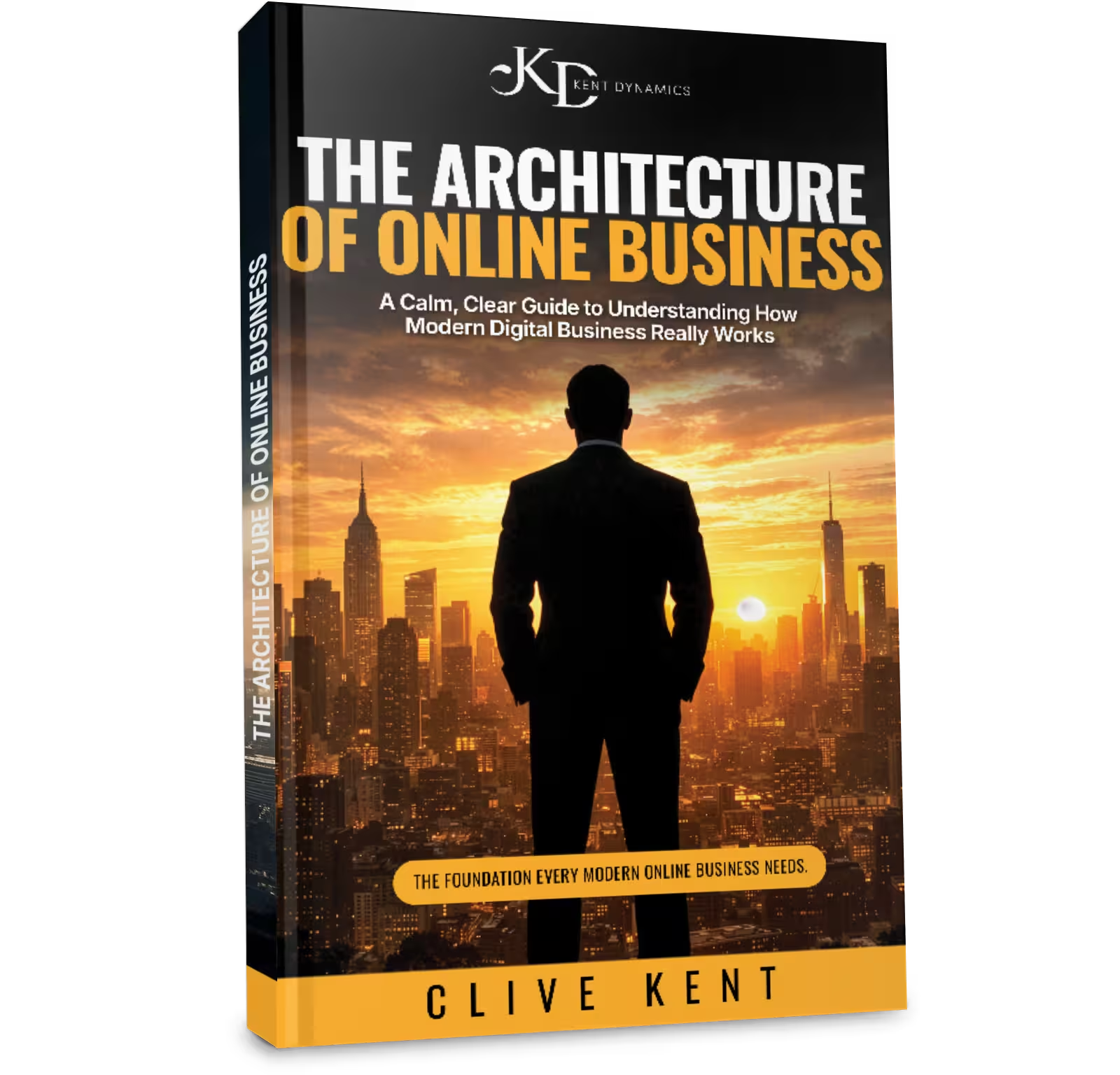
If you'd like the full version of this, the architectural map that every one of those PDFs is circling without quite naming, it's laid out chapter by chapter in The Architecture of Online Business. The book is short, deliberately. It's the structure underneath everything else you've bought, written in plain language, with no new tactics layered on top.
You don't need more information. You need the piece that makes the information you already have make sense.
Start with clarity
Clive Kent
If you’re building a digital business and want a clear, practical understanding of how it all fits together, this short book will give you the foundation to move forward with confidence.
YOU MIGHT ALSO LIKE

Kent Dynamics
About Kent Dynamics
Kent Dynamics is a creative and content support business working with entrepreneurs and small businesses building digital products and online brands. We provide practical design, content, and media support through a collaborative, conversation-led approach.


Start with clarity
If you’re building a digital business and want a clear, practical understanding of how it all fits together, this short book will give you the foundation to move forward with confidence.
Clive Kent
Kent Dynamics LLC provides creative and content support services to entrepreneurs and small businesses.
All products offered by Kent Dynamics LLC are digital unless otherwise stated. No physical goods are shipped.
Operating internationally.
© 2026 Kent Dynamics LLC. All rights reserved.
Home | Disclaimer | Terms and Conditions | Privacy Policy
For enquiries: hello@kentdynamics.com